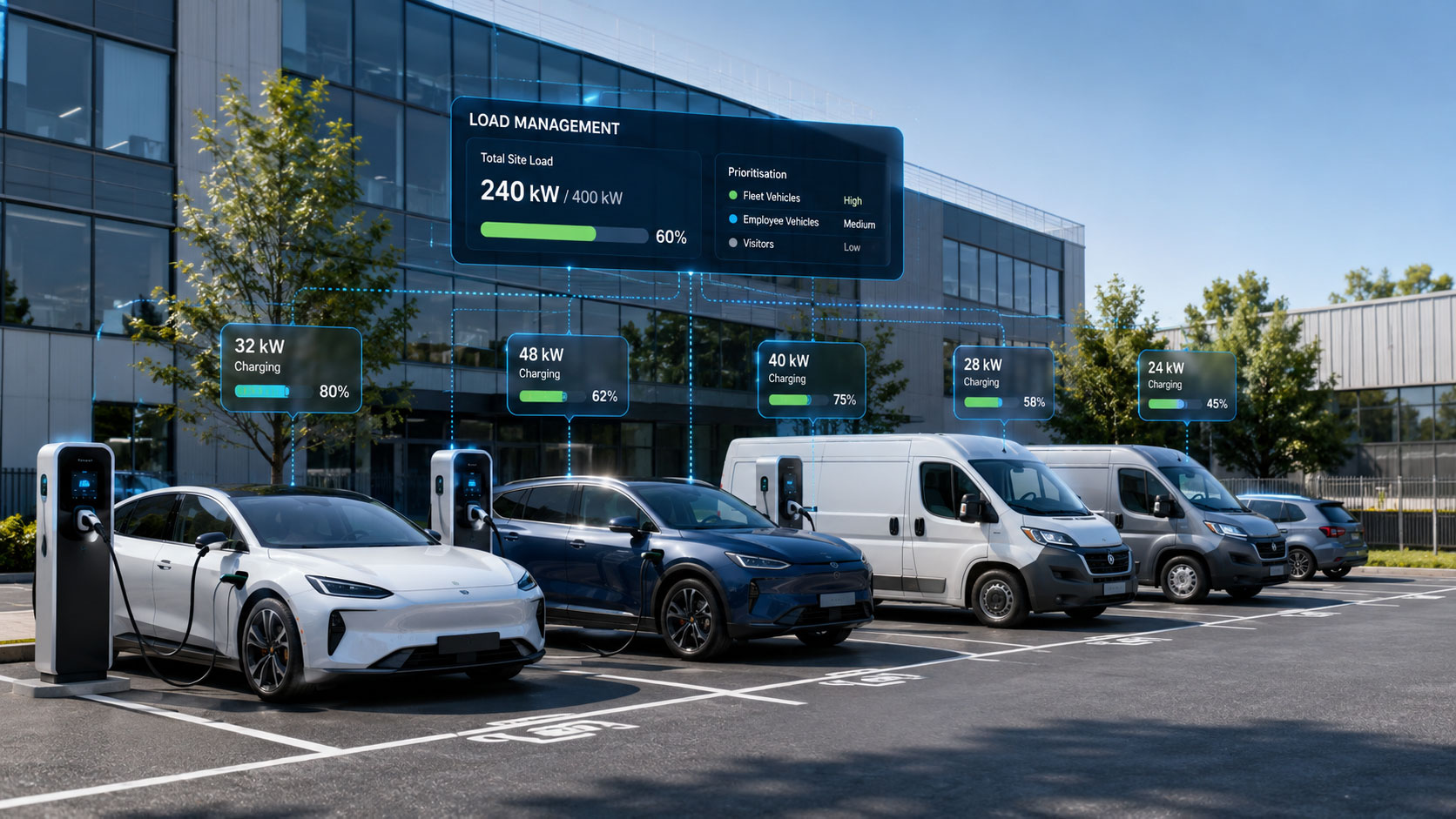
EV charger load management is becoming increasingly important for businesses installing multiple workplace or fleet chargers. As more vehicles need charging, one of the biggest practical questions is whether the existing electrical supply can support them without requiring an expensive upgrade.
That is where EV charger load management becomes important.
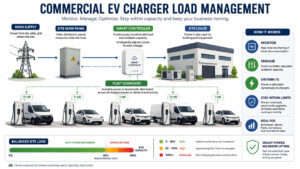
Instead of allowing every charger to draw its maximum power at the same time, a load management system can control how much electrical capacity is available to the charging infrastructure. For some businesses, this can make it possible to install several chargers without immediately committing to a larger electrical supply upgrade.
For businesses in Peterborough and surrounding areas, including parts of Cambridgeshire and Lincolnshire, proper planning is especially important where EV charging needs to operate alongside lighting, heating, machinery, IT systems and other commercial electrical loads.
Story Electrical provides commercial EV charger installation for workplaces, staff parking and fleet applications, alongside wider commercial electrical services. This guide explains how commercial EV charger load management works, when it may help and when an electrical supply upgrade may still be necessary.
Key Takeaways
- EV charger load management helps control the combined electrical demand created by multiple EV chargers.
- It can help a business make better use of the electrical capacity already available on site.
- Load management does not automatically remove the need for an electrical supply upgrade.
- The existing building demand should be assessed before deciding how much capacity can safely be allocated to EV charging.
- Workplace and fleet charging often benefit from a phased approach that allows additional chargers to be added later.
- Smart charging and dynamic load management can help reduce charging demand during periods when the rest of the site is using more electricity.
- Eligible businesses may currently receive support through the Workplace Charging Scheme, subject to the latest GOV.UK eligibility rules.
What Is EV Charger Load Management?
EV charger load management is a way of controlling how much electrical power is available to a group of EV chargers.
Without load management, several chargers operating simultaneously may each try to draw their full available charging power. Depending on the site, that combined demand could put unnecessary pressure on the existing electrical supply.
With a managed system, the available charging capacity can instead be distributed between connected vehicles.
For example, if a site has several chargers but only limited spare electrical capacity, the system may reduce the power available to individual vehicles when several are charging at once. As demand elsewhere in the building changes, the charging system can adjust the amount of power allocated to EV charging.
This can be particularly useful for:
- workplaces with staff charging
- fleet depots
- offices with multiple parking spaces
- warehouses
- commercial units
- hospitality venues
- schools and healthcare premises
- businesses planning to expand charging gradually
The aim is not simply to slow charging. It is to use the electrical capacity available to the site more intelligently.
Why Multiple EV Chargers Can Create a Capacity Problem
One EV charger may represent a manageable additional load for many commercial premises. Several chargers are different.
A business may already be using significant electricity for:
- lighting
- heating
- ventilation and air conditioning
- machinery
- commercial kitchen equipment
- refrigeration
- servers and IT infrastructure
- workshop equipment
- pumps and motors
- other specialist electrical equipment
Adding several EV chargers increases the site’s potential maximum demand. This is why charger planning should begin with the wider electrical installation rather than simply the number of parking spaces.
A business considering five or ten chargers does not necessarily need enough spare capacity for every charger to operate at maximum output continuously. Staff cars, for example, may remain parked for many hours and may not need maximum charging power throughout that period.
That difference between maximum possible demand and actual charging requirement is one of the reasons load management can be valuable.
How EV Charger Load Management Works
Dynamic load management goes further than setting a fixed maximum charging allowance.
The system can monitor the wider site’s electrical demand and adjust EV charging accordingly.
Imagine a workplace where electrical demand is relatively high during the working day. Machinery, heating, lighting and other equipment may all be operating.
If electrical demand elsewhere in the building increases, the charging system can reduce the power being allocated to EV chargers. When building demand falls, more electrical capacity can become available for vehicle charging.
In practical terms, this can help keep the site’s combined demand within an agreed limit.
Government-backed research published in 2025 found that smart workplace charging strategies can reduce energy loads and charging costs compared with unmanaged convenience charging. You can read the study summary through the GOV.UK research database.
UK regulations also require private workplace chargepoints sold in Great Britain to meet smart-chargepoint requirements. GOV.UK explains that smart functionality allows charging to be shifted away from periods of higher electricity demand. Read the Electric Vehicles (Smart Charge Points) guidance.
Can EV Charger Load Management Avoid an Electrical Supply Upgrade?
Sometimes, yes. But not always.
A business may have enough overall electrical capacity to support EV charging if that demand is managed intelligently. In that situation, load management could reduce or delay the need for an upgrade to the incoming electricity supply.
However, a site may still need additional capacity where:
- existing electrical demand is already close to the available supply
- a large fleet needs rapid turnaround
- vehicles have short charging windows
- higher-powered chargers are required
- significant future expansion is planned
- other new electrical equipment is also being installed
- the existing supply or distribution equipment is unsuitable
The installer therefore needs to assess the entire site, including:
- incoming supply capacity
- maximum electrical demand
- distribution boards
- existing major loads
- available spare capacity
- charger ratings
- number of vehicles
- vehicle dwell times
- expected charging patterns
- future fleet growth
If the existing site genuinely needs more power, the Distribution Network Operator may need to become involved. UK Power Networks explains the process for adding more power to larger commercial properties, including the need to establish the additional capacity required.
Businesses already considering a wider electrical upgrade can also read our guide to commercial three-phase installation.
EV Charger Load Management for Workplace and Fleet Charging
Staff charging and fleet charging can create very different electrical requirements.
Workplace charging for employees
Employee vehicles often remain parked for several hours. That means each vehicle may not need maximum charging power immediately.
If ten cars are parked for an eight-hour working day, a load-managed system can potentially distribute available charging capacity across those vehicles over a longer period.
This can make workplace EV charger installation particularly well suited to smart charging and load management.
Fleet charging
Fleet vehicles may have much tighter operational requirements.
A van returning to a depot in the evening and leaving early the next morning has a defined overnight charging window. Another vehicle may arrive much later but still need to leave at the same time.
Fleet charging design should therefore consider:
- vehicle arrival times
- departure times
- daily mileage
- battery capacity
- required state of charge
- charging speed
- priority vehicles
- overnight electrical demand
Our guide to fleet EV charging installation explains why fleet charging infrastructure should be designed around actual vehicle operations rather than simply installing the maximum number of chargers.

How Many Chargers Can Your Business Support?
There is no universal answer.
Two businesses with the same electricity supply could require completely different charging systems.
One company might have ten staff cars that remain parked for most of the working day and travel relatively low daily mileage.
Another might have ten commercial vans with short overnight charging windows and much greater daily mileage.
The second site may require considerably more charging capacity even though the number of vehicles is identical.
That is why the first question should not simply be:
How many chargers can we fit?
A better question is:
How much charging does the business actually need?
From there, the installer can assess:
- charger quantity
- charger output
- load management
- charging schedules
- vehicle priority
- current site capacity
- future expansion
We cover this decision in more detail in EV Charging for Businesses: How Many Chargers Should You Install?.
Three-Phase Power and EV Charging
Three-phase power can be useful for commercial EV charging because it allows electrical loads to be distributed across multiple phases.
However, having a three-phase supply does not mean a site has unlimited charging capacity.
The installer still needs to consider:
- existing building demand
- available supply capacity
- phase balancing
- distribution board capacity
- charger specification
- cable routes
- protective equipment
- future requirements
Some businesses may already have three-phase power but very little spare electrical capacity. Others may be able to support several chargers successfully when dynamic load management is used.
Where a supply upgrade is genuinely necessary, our guide to commercial three-phase installation and electrical capacity upgrades explains the wider considerations.
Why Charger Speed Is Not the Only Factor
Businesses often focus heavily on charger power.
A higher-powered charger sounds better, but faster charging is not automatically the right solution for every workplace.
The correct charger speed depends heavily on how long vehicles remain parked.
For example, a staff vehicle parked from morning until late afternoon has significantly more time available for charging than a fleet vehicle that needs to return to service within a few hours.
Installing unnecessarily powerful chargers may:
- increase peak electrical demand
- increase infrastructure requirements
- require larger cables
- affect distribution equipment
- increase installation complexity
A better approach is to match charger specification to real vehicle usage.
The same principle applies to the number of chargers. For some businesses, more lower-powered, intelligently managed charging points may make more operational sense than a smaller number of higher-powered units.
Planning for Future EV Growth
EV charging infrastructure should ideally be planned beyond the first installation phase.
A business may begin with four chargers today but expect:
- more employees to drive EVs
- additional fleet vehicles
- changes to company car policy
- greater visitor charging demand
- an expanded car park
- new electric commercial vehicles
Installing every future charger immediately may not make financial or operational sense. Planning the infrastructure for future growth can still be valuable.
This may involve considering:
- distribution board capacity
- cable containment
- charger locations
- communications infrastructure
- load management capability
- software compatibility
- future electrical demand
A phased approach can allow a business to install an initial group of chargers while preparing the electrical infrastructure for additional units later.
GOV.UK’s commercial chargepoint minimum technical specification sets requirements for chargepoints used under OZEV commercial grant schemes, including smart functionality and relevant electrical installation standards.
Workplace Charging Scheme Support in 2026
Businesses planning workplace charging should also check whether they qualify for the Workplace Charging Scheme.
Current GOV.UK guidance confirms that the scheme has been extended until 31 March 2027.
For qualifying installations completed from 1 April 2026, the scheme can cover up to 75% of eligible purchase and installation costs, capped at £500 per socket. Eligible applicants can claim for up to 40 sockets across their sites.
The grant is subject to eligibility requirements, and the installer claiming the grant must be OZEV authorised.
Businesses should always check the current GOV.UK Workplace Charging Scheme guidance before planning a project around available funding.
EV Charger Load Management in Peterborough
Story Electrical supports businesses with commercial EV charger installation in Peterborough and surrounding areas, including parts of Cambridgeshire and Lincolnshire.
Our commercial EV charging work can include:
- workplace EV chargers
- staff charging
- fleet charging
- multiple-chargepoint installations
- EV charger load management
- assessment of available electrical capacity
- distribution board requirements
- three-phase electrical considerations
- planning for future charging expansion
Every site has different charging requirements. A small office with several staff EVs may need a very different arrangement from a warehouse operating a commercial van fleet.
That is why charger numbers, power levels and load-management arrangements should be based on how the business actually uses its vehicles.
Does Your Business Need EV Charger Load Management?
If a business plans to install several EV chargers, load management should be considered as part of the overall electrical design.
It may help the site make better use of its existing supply capacity, particularly where vehicles remain parked for long periods and do not all require maximum charging power at the same time.
However, load management should not replace a proper electrical assessment.
The installer should first establish:
- what electrical capacity is available
- how much electricity the building already uses
- how much charging demand is expected
- when vehicles need to charge
- whether future expansion is planned
From there, the business can decide whether load management, a supply upgrade or a combination of both offers the most practical long-term solution.
Story Electrical provides commercial EV charger installation alongside wider commercial electrical services for businesses across Peterborough and surrounding areas.
Get in Touch
Story Electrical – Commercial EV Charging in Peterborough
Planning several workplace or fleet EV chargers?
Story Electrical can assess your existing electrical installation, available capacity and charging requirements before recommending a suitable setup.
This may include EV charger load management, three-phase considerations, distribution board work and planning for future expansion.
We support businesses across Peterborough and surrounding areas, including parts of Cambridgeshire and Lincolnshire.
Story Electrical – Commercial and Domestic Electrician
Address: Unit 14, Spitfire Business Park, Peterborough PE6 8W
Call: 01733 913133

About the Author
Mark Story is the founder and director of Story Electrical. He works with commercial and industrial clients in Peterborough and surrounding areas, delivering practical electrical solutions for working premises.
His work includes commercial EV charger installations, workplace charging, fleet charging, distribution board upgrades and wider commercial electrical services.
Story Electrical is NAPIT certified, and its electricians hold City & Guilds Level 3 qualifications.
Frequently Asked Questions
What is EV charger load management?
EV charger load management controls how much electrical power is available to a group of chargers. It can distribute available capacity between vehicles rather than allowing every charger to draw maximum power at the same time.
Can EV charger load management avoid a three-phase or electricity supply upgrade?
Sometimes. If the site has enough available capacity when charging demand is managed, load management may reduce or delay the need for a larger supply. Some sites will still require an upgrade because of existing demand, charger power or fleet charging requirements.
Can several EV chargers share the same available electrical capacity?
Yes. A properly designed load-management system can distribute available charging capacity between multiple chargers.
Is load management useful for fleet EV charging?
Yes. Fleet charging can benefit from load management, but the system should also take account of vehicle arrival times, departure times, mileage and the amount of charging each vehicle requires.
Does every workplace EV charger need to run at full power?
No. The required charging rate depends on how long vehicles are parked and how much energy they need before leaving.
Can three-phase power help with multiple EV chargers?
Yes. A three-phase supply can help distribute charging loads, but the available electrical capacity and wider building demand still need to be assessed.
How many workplace EV chargers can my business install?
That depends on available electrical capacity, charger output, vehicle charging requirements, parking duration and whether load management is used. A site assessment is needed to determine a suitable number and configuration.
Is the Workplace Charging Scheme still available in 2026?
Yes. Current GOV.UK guidance says the Workplace Charging Scheme is available until 31 March 2027. For qualifying installations completed from 1 April 2026, support is available for up to 75% of eligible purchase and installation costs, capped at £500 per socket and up to 40 sockets across an applicant’s sites.